

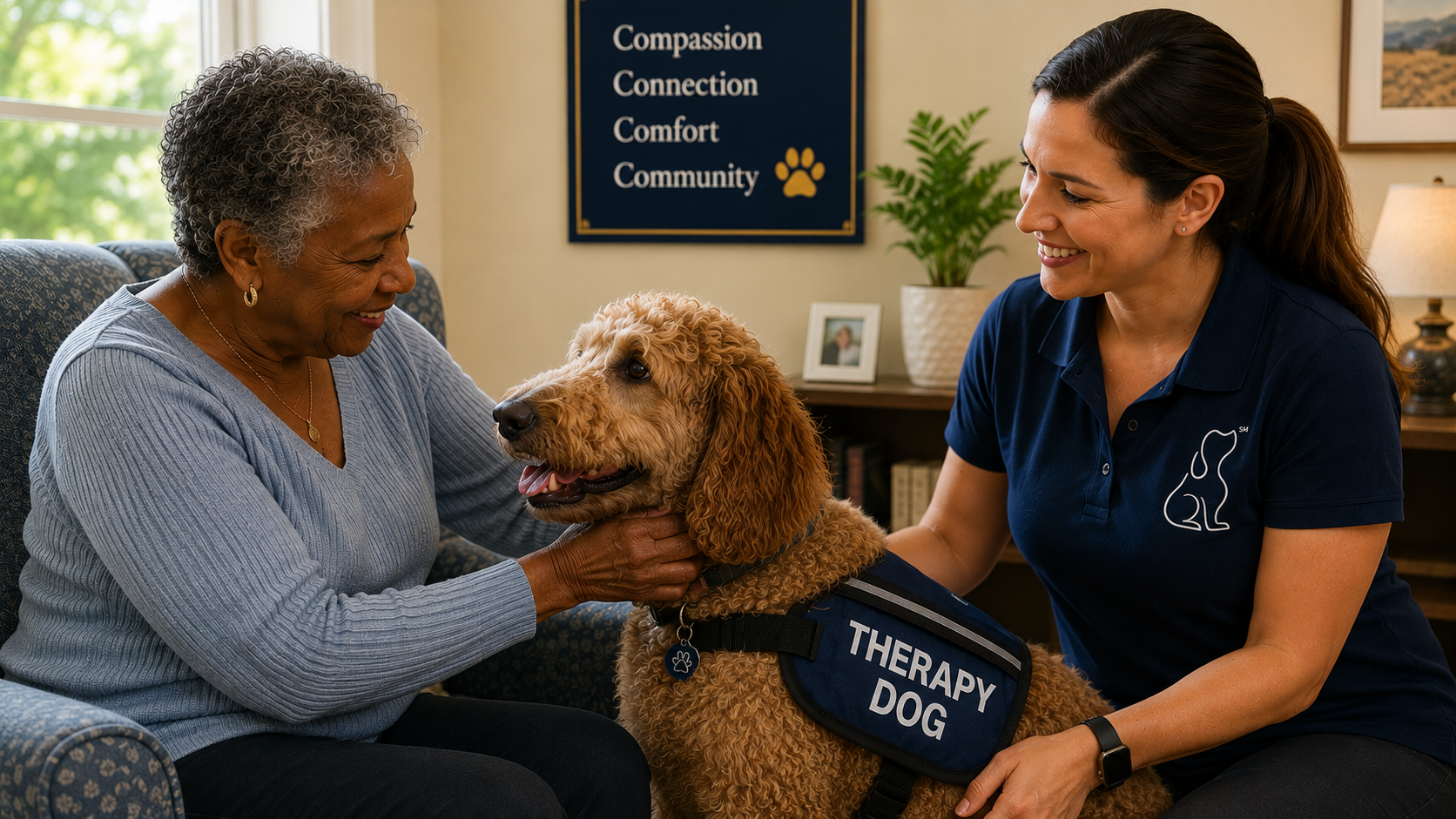
What Makes a Dog Eligible for Therapy Work • Popular Therapy Dog Certification Programs • Handler Responsibilities & Expectations • Training, Health, and Insurance Basics • Preparing for a Therapy Dog Evaluation

Therapy Dog Certification Tests
Therapy dog certification helps ensure that dogs and their handlers are prepared, safe, and effective when providing comfort and emotional support in a variety of settings. Below is an updated 2026 overview of major certification options, visit-based recognition, health & safety requirements, and practical guidance for selecting the best path for your dog and team.
Important: Therapy dog certification typically evaluates the handler-dog team, not just the dog. Most organizations assess temperament, obedience, environmental stability, handler control, and readiness for real-world visits.
1. Foundational Training — AKC Canine Good Citizen (CGC)
The American Kennel Club (AKC) Canine Good Citizen program remains one of the best foundational training programs to prepare a dog for therapy work. It teaches good manners, obedience, and public-friendly behavior.
- Skills Tested: Accepting friendly strangers, sitting politely for petting, proper grooming/examination, walking on a loose leash, responding to basic commands, calm behavior around other dogs and distractions, and good impulse control.
- Recognition & Versatility: CGC is valid for all dogs — purebred, mixed-breed, or rescues — and often serves as a recommended or required prerequisite for many therapy-dog certification organizations.
- Limitations: CGC alone does not test your dog’s reaction to therapy-specific settings such as hospitals, medical equipment, unpredictable noises, or vulnerable populations. It should be seen as a strong foundation, not the endpoint.
2. Major Therapy Dog Certification Programs
Pet Partners
Pet Partners is widely regarded as a leading national therapy-animal organization, offering structured preparation, evaluation, and ongoing registration for handler-animal teams.
Important: Pet Partners does not allow therapy animals on raw meat diets. For many households, this is a make-or-break eligibility issue and should be confirmed before pursuing evaluation.
- Process: Handler training, team evaluation, and registration. Their published guidance emphasizes both the handler’s readiness and the animal’s suitability for volunteer environments.
- Health & Hygiene Requirements: Therapy animals must meet strict infection-control standards — including current veterinary care, regular grooming, and no raw-meat diets. Pet Partners also requires animals to be at least one year old, reliably house-trained, and responsive to their owner’s direction and support.
- Visit Duration Limits: Pet Partners states that visits should not exceed two hours per day for any individual animal.
- Equipment & Behavior Standards: Animals must be well-trained, comfortable with strangers, and able to work safely within facility rules and handler control.
Therapy Dogs International (TDI)
Therapy Dogs International (TDI) is a long-standing registry known for rigorous temperament and obedience evaluations. However, as of March 2026, the organization is navigating significant administrative transitions that prospective volunteers should note.
- AKC Status Update: TDI is not currently appearing on the AKC’s list of recognized organizations. New service hours logged through TDI may not currently qualify for official AKC Therapy Dog titles.
- Administrative Note: Due to a prolonged technical outage and data recovery efforts, many handlers have reported substantial delays in certification processing and member communication.
- Key Evaluations: Testing remains focused on controlled obedience, distraction tolerance, and calm behavior around wheelchairs, walkers, and medical equipment.
- Exclusivity Policy: Handlers should verify TDI’s requirements regarding dual-registration, as they historically prohibit membership in multiple national therapy dog registries.
Alliance of Therapy Dogs (ATD)
Alliance of Therapy Dogs (ATD) certifies handler-dog teams and provides liability coverage for qualifying volunteer work.
- Certification Process: Initial temperament and handling assessment followed by supervised observation visits before full approval.
- Maintenance Requirements: To keep membership in good standing, teams must complete and log at least one in-person volunteer visit every three months.
- Health Requirements: ATD’s current published materials state that therapy dogs must be at least one year old, current on locally required vaccines, have a negative fecal test every 12 months, and be clean and well groomed for each visit.
- Liability Insurance: ATD provides liability coverage for qualifying volunteer visits when members follow program rules and approved procedures.
- Background Checks: ATD’s certification packet includes proof of a completed background check as part of the application process.
Therapy Dogs United (TDU)
Therapy Dogs United (TDU) has been described by handlers as a scenario-based option for teams preparing for real-world therapy visits. Because publicly accessible official program details are more limited than those of AKC, Pet Partners, TDI, or ATD, handlers should verify current evaluation standards, insurance, and facility acceptance directly with the organization before relying on it as a primary certification path.
- Focus: A practical, visit-readiness approach may appeal to first-time therapy teams or dogs new to exposure work, but published requirements should always be confirmed directly with the program.
3. AKC Therapy Dog Titles (Visit-Based Recognition)
After certification or registration with a recognized therapy-dog organization and once you begin logging facility visits, your team may become eligible for official AKC Therapy Dog Program recognition. The titles reflect sustained work and service.
| Title | Name | Minimum Visits |
|---|---|---|
| THDN | Therapy Dog Novice | 10 |
| THD | Therapy Dog | 50 |
| THDA | Therapy Dog Advanced | 100 |
| THDX | Therapy Dog Excellent | 200 |
| THDD | Therapy Dog Distinguished | 400 |
| THDS | Therapy Dog Supreme | 600 |
Because AKC title eligibility depends on certification through an AKC-recognized therapy dog organization, handlers should confirm that their chosen registry appears on AKC’s current recognized-organizations list before assuming visits will qualify.
These titles reward ongoing commitment to therapy work and give facilities a way to recognize experienced, reliable therapy teams. They do not replace the need for certification or registration through a recognized therapy dog organization.
4. Health, Hygiene & Handler / Team Requirements
- Veterinary care & vaccinations: Up-to-date legally required vaccinations, regular veterinary care, and good general health are baseline expectations. Many organizations require current health paperwork before certification or renewal.
- Grooming & cleanliness: Cleanliness is critical to infection control — dogs should be bathed as appropriate, nails trimmed, and free of odor or parasites.
- No raw-meat diets / strict dietary rules: For safety and hygiene, some therapy-dog programs — notably Pet Partners — prohibit raw diets for visiting animals. Always review the dietary rules of your chosen organization.
- Control and behavior reliability: Animals must be calm, well-trained, and responsive to handler commands at all times — including around medical equipment, noise, and in high-stress environments.
- Handler professionalism: Handlers must ensure their dog’s well-being, follow facility policies, maintain control of the dog, and be prepared to end visits if the dog shows stress, fatigue, or discomfort.
5. Insurance, Background Checks & Facility Onboarding
Before visiting any facility, it’s important to confirm that your therapy-dog team meets all organizational and facility requirements related to safety, liability, and conduct.
- Liability insurance: Some certifying organizations (for example, ATD and Pet Partners) provide volunteer-team liability coverage for qualifying therapy visits. Coverage often applies only when the team is volunteering and following all program rules.
- Background checks & handler screening: Many therapy-dog organizations require handlers to complete background screening, and facilities may impose additional credentialing — especially for hospitals, schools, or senior-care centers.
- Facility compliance: Facilities may have their own rules, including medical clearance, dress code, scheduling limitations, infection-control training, or documentation requirements. Always confirm their policies before scheduling visits — and when in conflict with organizational policies, follow the more restrictive rule.
6. Practical Tips from Experienced Handlers
- Train your dog to reliably ignore food on floors or tables, and never allow pawing or jumping on clients — even if clients encourage it.
- Expose your dog to wheelchairs, walkers, oxygen tanks, IV poles, medical equipment, noises, and unpredictable movement during training so they get used to realistic therapy environments.
- Practice sudden touches or light physical contact (for example, gentle taps on harness or shoulders) and maintain calm, controlled posture — the handler’s energy sets the tone.
- After each visit, always clean or change any gear, leashes, vests, blankets, or bedding used during the visit to reduce cross-contamination risk.
- Remember that certification tests evaluate readiness for volunteer environments, but they do not guarantee that every dog will thrive in every facility or population served.
7. Choosing the Right Certification or Service Path
| Your Goal | Recommended Path / Organization |
|---|---|
| Build basic manners & public readiness | 🐾 AKC Canine Good Citizen (CGC) |
| Join a structured, widely accepted therapy-animal network | 📋 Pet Partners |
| Get insured volunteer status + team certification + flexible service | 🛡 Alliance of Therapy Dogs (ATD) |
| Explore scenario-based visit-readiness work after verifying current standards directly | 🎯 Therapy Dogs United (TDU) |
| Achieve long-term recognition for consistent service | 🏅 AKC Therapy Dog Titles (THDN–THDS) |
8. Local & Facility Considerations (Fairfax, VA / Northern Virginia)
In the Northern Virginia area, many therapy-dog teams operate in settings such as:
- Hospitals (e.g., Inova Fairfax Hospital)
- Public libraries (e.g., Fairfax County Public Library)
- Veterans’ centers, senior living & retirement communities
- Schools, counseling centers, and community outreach programs
Important Note: Facilities may impose their own policies such as vaccination requirements, background checks, hygiene protocols, onboarding paperwork, or scheduling limits. When facility rules are stricter than organizational policies, always follow the facility’s requirements. Confirm expectations with volunteer coordinators before scheduling visits.
9. Next Steps
- Begin with CGC (or equivalent foundational training) to ensure strong public-behavior readiness.
- Select the therapy-dog organization that fits your goals and facility targets (for example, Pet Partners, or ATD).
- Complete health screening, handler training, and registration according to your chosen organization’s published requirements.
- Start therapy visits and track them diligently — especially if you’re working toward AKC Therapy Dog titles.
- Maintain ongoing hygiene, training, and compliance — including periodic re-screenings, renewal evaluations, and adherence to facility rules.